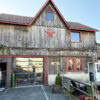
Rabbit Hill Farms started as fifth generation farm, growing fruits and vegetables, but shifted to grain in 2002 when weather and storms made grain farming a more reliable crop. Today the farm and malt house is run by Hillary Barile and brother Blair. In 2015 they started selling malted grain to local breweries. (Malting is the process of taking harvested grain and creating the conversion of starches by first germinating it, then drying the kernels. Without that process making beer from grain is not viable. Virtually all grain that goes into beer has to be processed into malt before brewing).

Welcome to Rabbit Hill’s Malt House in Shiloh NJ
Ten years later, a lot has changed At Rabbit Hill. According to Hillary, it happened very fast, and the first brewers interested were the folks at Cape May Brewing. They were creating a beer called “Three Plows” which was brewed with all NJ ingredients. Hillary commented: “We told the Cape May guys ‘here’s what we want to do – do you have interest?’. They did. And it’s especially gratifying that Chris and Brian who were from Cape May are back with us again as Wanderback, as they were our first customer and we don’t like to lose customers!”
Hillary explained how the use of craft malt grew: “When we started our grain was mostly used by breweries for ‘special projects’ – like making a special saison, which is of course, a farm style. But now we have more products and are sourced more – the growth in popularity of craft lager has also celebrated the malt. That’s a style that allows the grain to really be appreciated. Now we are used in all types of beers and a regular source for beer ingredients from several breweries – not just something “precious” to only be used for specific special beers.”
Even with the recent headwinds in the industry, In the past 3 – 4 years Rabbit Hill has picked up a lot of new customers. Hillary explained: “We increased our capacity, so were able to say yes to more people, and currently we are close to bumping up to what we can responsibly do. We have been very conservative in our growth as we don’t want to expand to the point that we can’t do it ourselves, in the way we want to do it, with our floor malting. It’s just me, my brother and a part time worker in the malt house. If we grow too much we could lose part of what makes us who we are – hands on.” (Hillary explained to me that this situation is as much a limitation as the cost and need for new facilities to expand).

Bags of the “good stuff”…
But Rabbit Hill does more than just grow and malt their own grain. “We malt other farm’s grain too – ‘Screamin’ Hill’ has been with us for almost all 10 years, and recently we started doing it for Needle Creek Farms in northern Jersey. They grow their own barley and ship it to us, we malt it and ship it back. We are about to start malting for Bent Iron Farms too. We are all about showing people what a farm brewery can look like. All grain has to be malted to use for brewing and the entire brewing process takes a lot of information, knowledge, skill and infrastructure. You have to grow and harvest the grains, then malt it and then brew with it. We are happy to be part of that infrastructure. We support farm breweries.”

Hillary, her brother and father on the malting floor
I asked her about possible further expansion: “We could possibly grow more grain, or source it from local farmers that grow grain to our standards, and we could further build out the malting floor. But for us it’s about staying involved, doing it ourselves. My brother and I are the fifth generation of farmers, and we understand the continuum of the past and the future of farms. Right now this volume is the best we can responsibly manage ourselves. We are just bold enough to try new ideas, but we want to keep being responsible.”
Hilary sees opportunities ahead, even as the beer and distilling industry grapples with changing consumer preferences. “We are very optimistic as we know the types of brewers that want to work with us and like what we are doing. Like Wanderback, for example, they are very focused on using local ingredients, its core to their identity, and their brand is growing. They are celebrating their ingredients including our grain. (Justin Vitti from Wanderback told me that they like the historical tie back to how European brewers used to do it, surrounded by their own farms, using their own grain).
Not all breweries that feature Rabbit Hill malt are farm breweries. Hillary describes some of the other NJ breweries they work with. “Kane is of course very popular, though they don’t only use our grain. They use us for their barrel aging program (not the stout) but other showcase beers like their saison. We are part of their normal ingredient sourcing, so we don’t always know which beers our grain goes into. We do know it’s in ‘Head High IPA’ (a great beer) which serves as a quick answer to the question “what beer are you in?”. Tonewood also uses us, they have a program where they bring in different malts to try new ingredients. We know they use our malted wheat in their ‘Freshies’ pale ale.
Speaking about the environment and environmental change, Rabbit Hill has also had to adapt. “We are growing new varieties of grain that suit our evolving climate.” says Hillary. “We used to always source our seed from the Cornell breeding program, or get seeds from Europe, but now we are working with Virginia Tech’s program. VT is providing varieties that adapt well to this region, we are excited about it. South NJ’s weather is getting more like Virginia and we are positioning for that.”

Harvest time
Hillary continues: “We believe in sustainability, and we believe that the less miles our ingredients travel the better. We support a local supply chain, it’s just better to keep things close by. If you drew a concentric circle around us – say 60 miles, that’s when most of our malt does. Like out to Atlantic City (The Seed Brewery) maybe that’s 40 miles. It just feels right to stay close to home. We think it’s important and so do our customers, it’s one of the reasons that like using us. It’s a connection to “the farm”and helps them meet their sustainability goals.”
I had to ask about the current consumer interest in “local” ingredients and “authenticity” as I can’t imagine a better example than brewing with local farm raised ingredients like craft ,malted grain. I asked Hillary why she thinks that people aren’t more excited about craft malt. “Well, it’s not actually that compelling a story to tell. The idea of fresh local fruits and vegetables, that resonates, everyone knows vine ripened fresh fruit tastes so much better, like local strawberries or tomatoes. These farm products come in seasonally and taste much better than what you buy at the supermarket. That sticks in the mind. But grain is different, is dried, it can be stored, it’s always available all year round. It’s just harder to get people’s attention. But the freshness component is there, we kiln it and deliver it to the customer sometimes in the next week. It definitely adds to the flavor, but it’s more nuanced, not as obvious to consumers like fresh fruit.”
I commented to Hillary that the floor malting process that Rabbit Hill uses is historic and authentic, to me almost romantic. “Yes, floor malting captures that transformation process, it is so sensory – the smells, the tastes and feels, it’s a complete experience. This is one of the reasons we want to stay at a manageable size – we want to continue to celebrate that authentic process. But most people don’t understand that beer is an agricultural product like other things you eat and drink in a day, and it all started on a farm, it is not just manufactured.”
What does Hillary and Rabbit Hill like best about their business? “We like to build our relationships over time, we love the business – to us it’s more than a transaction. We get to know our customers well, and we really enjoy that part of the business. You don’t go into brewing to make a lot of money – like you don’t go into farming for that reason. It’s about having passion for something, excitement, it’s a calling, a kinship.

Rabbit Hill’s grain used to create delicious beers in NJ
This powerful combination of passion, mission, caring and quality product make Rabbit Hill a great partner for a New Jersey brewer to have. As the brewer Dorien Saunders from “Whims Brewery” in Atco, New Jersey says” Rabbit Hill’s product is just superior for brewing. While the average consumer might not understand it, Rabbit Hill does a really great job with the conditioning of their malt, the quality and efficiency, it’s amazing how well it performs in the brewing process.” Brett Bullock, the co-owner of the “Screamin’ Hill Farm” brewery in Cream Ridge NJ, who uses Rabbit Hill to malt his grain, says: “We just love Rabbit Hill, and they are critical to our business. Hillary and (her brother) Blair are awesome. We very much appreciate what they do.”